Why
Your Legacy Partners (YLP) is a boutique financial services firm that provides valuations for wealth management businesses across the country. The owner, Nick, came to me looking for a solution to streamline his analysis pipeline so that he could service more clients and keep his sanity.
Their existing process involved juggling spreadsheets, reports, powerpoint, and emails between Nick and his employees and clients. They spent a huge percentage of their time on low value office work, leaving little time to spend on evaluating the unique aspects of each client’s business, their main value proposition.
They were bursting at the seams trying to service their existing clientele. Nick needed a solution and he needed one fast.
The goal was straightforward but not simple, find a way to streamline their pipeline but not limit the flexibility of the YLP team when performing their analysis.
What
The YLP web application I built includes a client facing portal, an internal analysis dashboard, and a tight integration with Google Sheets.
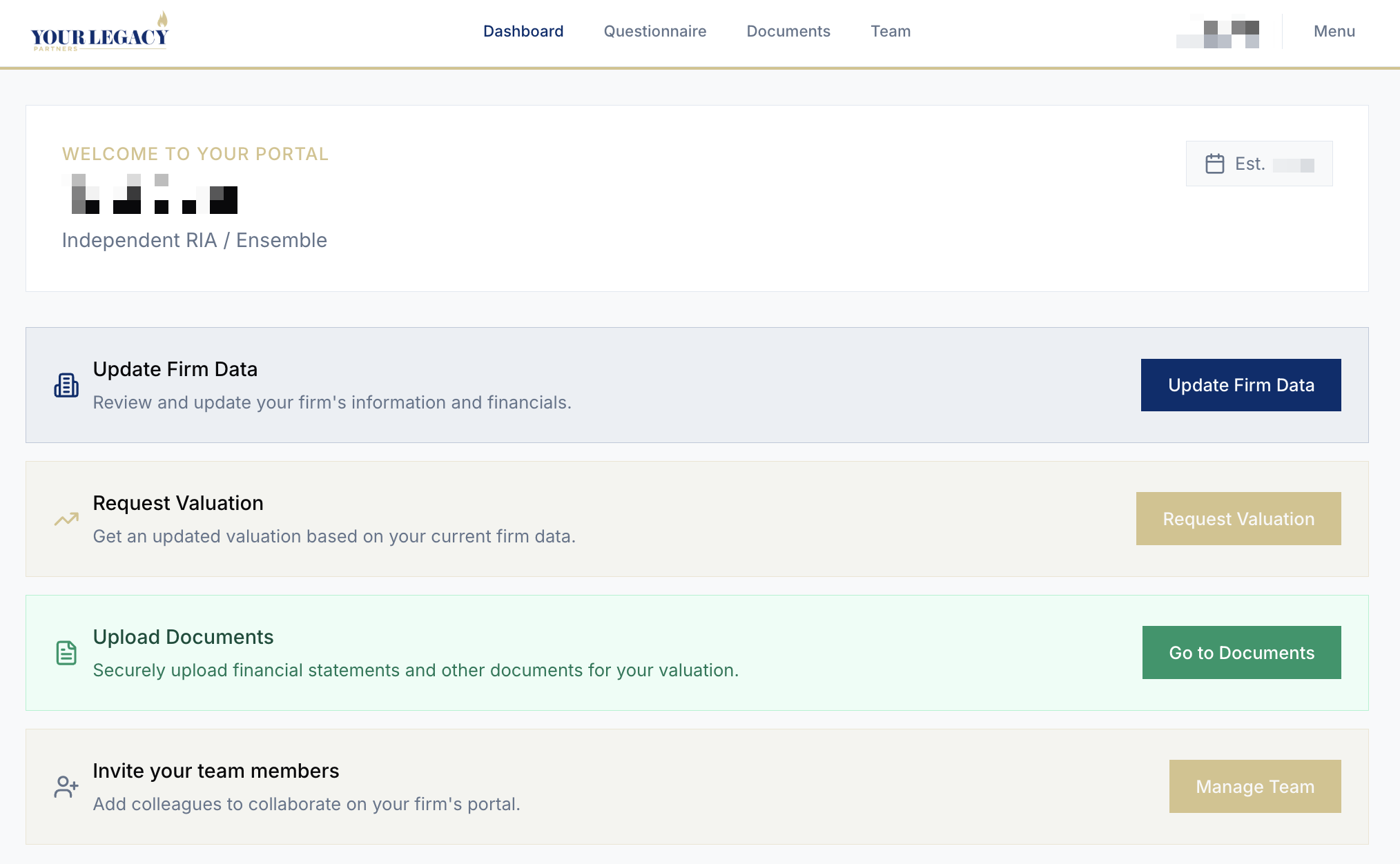
The process starts with YLP’s clients logging into a streamlined web portal. Here the client filles out a comprehensive questionnaire that captures insights into how the firm operates which are later fed into Your Legacy Partner’s proprietary valuation model. Clients also upload required documents into a secure document portal, instrumented with a access log for strict auditability.
Once a Client has finished the onboarding process, a new financial model is scaffolded out in Google sheets, prefilled with the information provided. Nick and his analysts work through the multiple phases of their financial analysis, capturing minute details of each business and ultimately normalizing into higher level metrics (EBITA, growth rates, projections, etc).
The backend of the web app syncs to and from the google sheet for each valuation, bringing in these key metrics for further processing. The YLP team continues their analysis through a guided multi-phase process in the internal web dashboard. This combines the pure financial metrics with qualitative data from the client’s questionnaire submission.
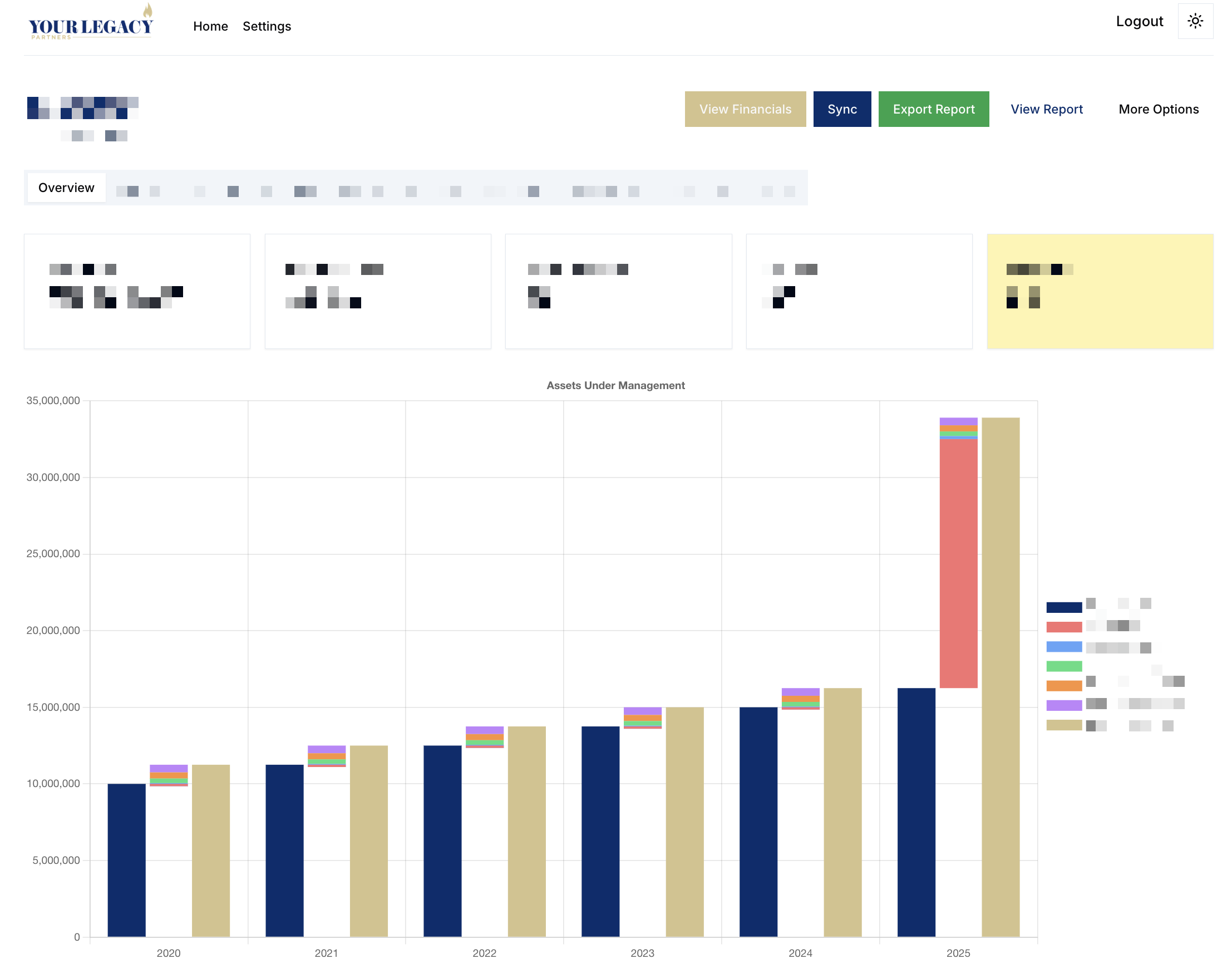
Once the full process is done, a comprehensive report is generated for the client. The report walks through the full analysis process. Covering the data used, the modeling approaches taken, and offering insights into the strengths and weakness of the firm.
The output of this end to end flow is a final valuation number for the client, backed by thorough and exhaustive analysis. This valuation is often used as the basis for financing decisions and M&A activity between firms.
Results
Once deployed, this application brought the turn around time per analysis from weeks to days. More importantly, it allowed the YLP team to spend a much larger portion of their time applying expertise to the modeling process and providing value to their clients. The rest of the tedious and repetitive work is now streamlined and automated.
Now that this platform has been in use for multiple years, Nick’s investment is now compounding even more. His clients often come back for a repeat valuation on a quarterly, semi-annual, or annual basis. These repeat valuations pull directly from previous iterations and can be completed in a fraction of the time.
The addition of a self serve portal has also reduced the YLP team’s operational friction of working with clients and centralized all document processing so key information is never lost.
Nick has been able to effectively expand his team, service more clients, and spend much of his own time broadening YLP into other complementary business offerings.
Challenges
To kick off this project, I had to work closely with Nick to gain a deep understanding of his analysis process. Having never done sophisticated finance and accounting work before, there was a pretty steep learning curve to grok many of the concepts before even starting any of the application design.
After understanding the existing process, the next challenge I faced was the flexibility Nick required during the analysis process. There were seemingly endless edge cases and subtle differences between how he approached firms of varying types. After working through a few prototypes, I realized sometimes its best not to reinvent the spreadsheet shaped wheel.
A tight integration with Google Sheets let the YLP team leverage their decades of experience working with spreadsheets, and allowed me an API to extract key information needed for the remainder of the analysis outside of the financials. This was the key decision that allowed me to provide a solution to Nick that met his needs in a timely manner and on a reasonable budget.
But integrating something this flexible came with many of its own challenges. I had to develop a lot of custom tooling to work with the analysis spreadsheets, especially as they evolved over time.
For example, when doing a repeat analysis for a client, I would clone their existing valuation, pull in the latest data provided, and manipulate the spreadsheet structure so it was ready for analysis. This sounds relatively simple on the surface, but this tooling has to account for differences between template types and changes introduced that were unique to this client in the previous valuation.
If you can imagine playing blindfolded chess against yourself, thats basically how it felt to develop this.
Summary
Working with Nick and the YLP team was very rewarding. It was a fun change of pace from my normal day to day work and required some out of the box thinking to meet their requirements. I enjoyed working across the stack, from doing backend systems design to frontend UI/UX work. Its incredibly satisfying to deliver something that Nick, his team, and his clients can all get value from every day.